
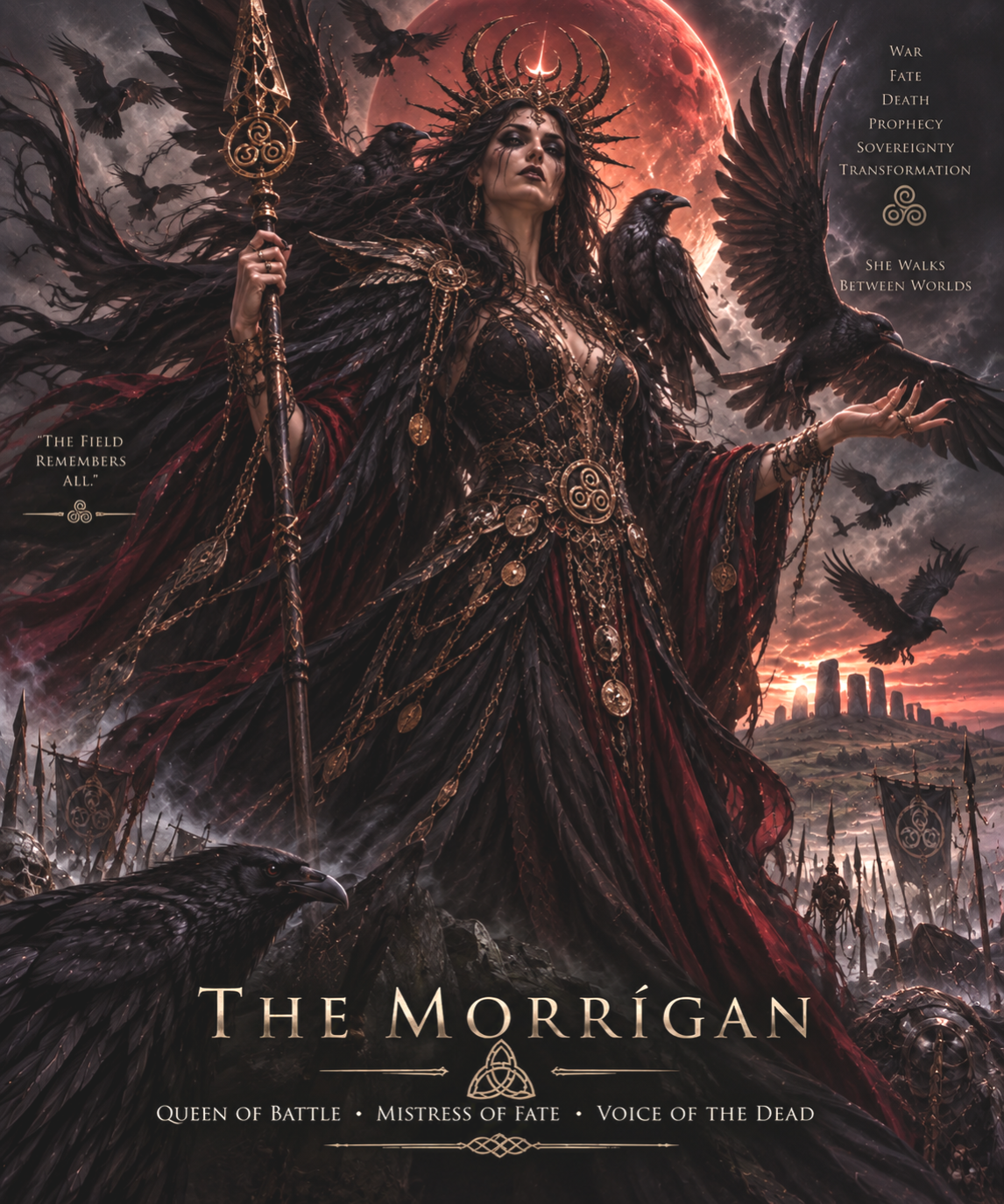
THE MORRÍGAN
The Threefold Goddess of War, Death, Sovereignty & the Battlefield
Temple of Nyx | Divine Goddesses, Ancient Mythology & the Mysteries of the Underworld
The Great Queen of War and Fate
In the ancient mythology of Ireland, few divine figures command the same association with war, prophecy, death, and sovereignty as the Morrígan.
Known as the Great Queen or Phantom Queen, the Morrígan is a supernatural figure associated with the Tuatha Dé Danann, the divine people of ancient Irish tradition. Her presence is felt throughout stories of warfare, the struggle for sovereignty, and the uncertain boundary between life and death.
She is not simply a goddess who enters battle carrying a weapon. Her power is represented through the fate of warriors, the terror that overtakes armies, the prophecy of approaching death, and the supernatural forces that influence the outcome of war.
The Morrígan can appear as a beautiful woman, an elderly prophetic figure, or a crow overlooking a battlefield. Her ability to transform reflects her mysterious nature and her connection to forces that cannot be controlled by ordinary human strength.
In the ancient Irish tradition, the Morrígan is also associated with a group of three closely connected war goddesses known as the Morrígna. Their identities overlap across different surviving manuscripts, but together they represent the many dimensions of warfare, sovereignty, and supernatural power.
The Threefold Nature of the Morrígan
The Morrígan is frequently described in modern spiritual traditions as a threefold goddess, expressing different aspects of her power through three divine feminine figures.
In the medieval Irish text Lebor Gabála Érenn, the three daughters of Ernmas are identified as Badb, Macha, and the Morrígan, who is also called Anand.
Other traditions associate Nemain with this group of war goddesses.
For this reason, the threefold nature of the Morrígan is best understood as a complex relationship between several closely connected divine figures rather than one fixed arrangement preserved identically in every ancient source.
I. Badb — The Battle Crow and Herald of Death
Badb, also known as Badb Catha, is one of the most fearsome goddesses associated with the Morrígan.
Her name is closely connected with the crow, particularly the dark birds that gather above battlefields.
Badb represents the terrifying presence of approaching death. Her supernatural cries could spread fear and confusion among warriors, disrupting their courage and influencing the course of battle.
She was also associated with prophecy and the announcement of impending destruction.
In Irish tradition, Badb sometimes appears as a mysterious woman washing bloodied equipment at a river crossing. This image, known as the Washer at the Ford, serves as a supernatural warning that a warrior's death may be approaching.
What Badb represents:
Badb embodies the terrifying uncertainty of warfare, the approach of death, and the supernatural forces believed to influence the fate of warriors.
Her crow form symbolizes the presence of death upon the battlefield and the mysterious relationship between the living and those who have fallen.
Within a spiritual interpretation, Badb may also represent the necessity of confronting fear, recognizing danger, and understanding that every battle carries consequences.
II. Macha — The Goddess of Sovereignty, Power and War
Macha is another powerful figure associated with the Morrígan and the divine sovereignty of Ireland.
Her mythology connects her with warfare, horses, kingship, territorial authority, and the relationship between a ruler and the land.
Unlike Badb, whose imagery emphasizes the terror and prophecy of battle, Macha is closely associated with sovereignty and the authority of those who govern.
Several figures named Macha appear in Irish mythology, and their stories are not always identical.
One famous tradition describes Macha as a supernatural woman forced to race against the king's horses while heavily pregnant. After winning the race and giving birth, she places a curse upon the men of Ulster, causing them to experience debilitating pains during their greatest time of need.
The story illustrates the consequences of violating a woman's dignity and abusing authority.
What Macha represents:
Macha embodies sovereignty, territorial authority, strength, and the consequences of dishonoring sacred obligations.
Her association with warfare extends beyond the battlefield itself. She represents the relationship between power and responsibility, and the consequences that may follow when authority is misused.
In a spiritual interpretation, Macha can symbolize the defense of one's sovereignty, the protection of sacred boundaries, and the responsibility that accompanies positions of leadership.
III. The Morrígan — The Great Queen, Prophecy and the Fate of Warriors
The Morrígan herself is the third figure named in one of the principal medieval accounts of the three daughters of Ernmas.
In this tradition, she is also called Anand.
She is associated with warfare, supernatural transformation, prophecy, sovereignty, and the fate of those who enter battle.
The Morrígan's mythology illustrates that the outcome of war is not determined by physical strength alone.
Her influence extends to the courage of warriors, the fortunes of armies, and the supernatural forces believed to surround conflict.
In the Táin Bó Cúailnge, she encounters the warrior Cú Chulainn and offers him her assistance. When he rejects her, she intervenes against him through a series of transformations, appearing as an eel, a wolf, and a heifer.
Their encounters demonstrate her shapeshifting abilities and her capacity to influence the course of battle.
What the Morrígan represents:
The Morrígan embodies divine sovereignty, prophecy, the power of transformation, and the mysterious relationship between warfare and fate.
Her presence reminds warriors that battle is not merely a contest of weapons. It is also a confrontation with fear, mortality, destiny, and the consequences of one's actions.
Nemain — The Supernatural Fury of Battle
Although the threefold grouping above identifies Badb, Macha, and the Morrígan, another important goddess deserves recognition.
Nemain is a supernatural figure associated with the frenzy, terror, and confusion of warfare.
Her name appears in Irish traditions concerning the psychological devastation of battle. She is associated with the panic that can overwhelm warriors and cause an army to lose its discipline.
Nemain is sometimes identified with Badb or included among the wider group of war goddesses associated with the Morrígan. However, her precise relationship to the other goddesses varies across the surviving sources.
In spiritual symbolism, Nemain represents the uncontrolled fury of warfare: the moment when fear, aggression, and chaos overcome reason.
The Morrígan and Her Involvement in War
The battlefield is one of the most important settings in the mythology of the Morrígan.
She is not portrayed simply as an observer of warfare. Her presence can influence the confidence of warriors, foretell destruction, and strengthen or undermine those who enter combat.
The Second Battle of Mag Tuired
One of the Morrígan's most significant appearances occurs in the Cath Maige Tuired, the Second Battle of Mag Tuired.
This ancient Irish narrative describes a great conflict between the Tuatha Dé Danann and the Fomorians.
Before the battle, the Morrígan encounters the Dagda, a powerful figure among the Tuatha Dé Danann, and promises her assistance.
During the conflict, she encourages the Tuatha Dé Danann and participates in the supernatural struggle surrounding the battle.
Following their victory, she proclaims the outcome and delivers prophetic words concerning the future.
Her involvement illustrates the relationship between divine power and the outcome of warfare in Irish mythology.
The Morrígan represents more than the destruction of an opposing army. She is associated with the struggle for sovereignty, the defense of a people, and the supernatural forces that accompany the transformation of an established order.
The Crow Upon the Battlefield
The crow is among the most recognizable symbols associated with the Morrígan and Badb.
In the aftermath of battle, crows and ravens gather around the fallen. Their presence became associated with death, prophecy, and the supernatural world.
Within the mythology of the Morrígan, the crow is not merely a creature of darkness. It is a symbol of the threshold between life and death.
The image of a dark bird overlooking a battlefield represents the inescapable reality that every warrior must eventually confront mortality.
The Morrígan, Hell and the Realm of the Dead
The Morrígan's connection to death raises an important question: does she represent Hell or possess authority over the Underworld?
To understand this relationship, it is necessary to distinguish between ancient Irish mythology and later spiritual interpretations.
The Morrigan is understood to be a force of death. She arrives when war breaks out and blood is spilled upon sacred lands—when those who pledge their devotion to the Almighty Father are quick to sin against Him.
She is not here to save anyone. She desires only one thing: to consume the blood of those foolish enough to kill in the Father’s name. The Father has never permitted anyone to kill, yet countless texts claim that killing in His name is an act of faith. This is not the will of the Almighty Father.
Those who kill in the name of religion or commit other selfish atrocities are met by goddesses such as the Morrigan. There is no escaping her—or her vampires.
The ancient Irish understanding of the Otherworld
Ancient Irish mythology does not describe Hell in precisely the same way as later Christian theology.
Instead, Irish tradition contains accounts of the Otherworld, a supernatural realm associated with divine beings, mysterious landscapes, and existence beyond ordinary human experience.
The Otherworld is not simply a place of punishment. It can be represented as a realm of extraordinary beauty, abundance, supernatural encounters, and beings who exist beyond the limitations of mortal life.
The Morrígan is connected with supernatural powers, prophecy, and death, but the surviving mythology does not establish her as the sole ruler of Hell or the sovereign queen of the entire Otherworld.
The battlefield as a representation of Hell
Although the Morrígan is not historically established as a ruler of Christian Hell, her mythology provides powerful imagery through which the experience of Hell can be understood symbolically.
A battlefield can become a place of extraordinary suffering.
The cries of the wounded, the destruction of armies, the fear of approaching death, and the devastation left behind by warfare create an environment that resembles what many people imagine when they think of Hell.
The Morrígan stands at the center of this imagery.
She represents the supernatural presence associated with the battlefield, where the boundaries between life and death become painfully apparent.
In this interpretation, Hell is not necessarily a separate physical kingdom under her command. It is also a symbolic representation of the suffering, terror, destruction, and transformation that accompany warfare.
The Morrígan's connection with the battlefield therefore provides a way of contemplating the darker aspects of existence: mortality, suffering, the consequences of violence, and the transformation that follows destruction.
Death, transformation and rebirth
The Morrígan's association with death can also be understood through the symbolic relationship between endings and new beginnings.
When an established order collapses, another may emerge.
When a warrior confronts mortality, the experience can transform their understanding of life.
When a conflict ends, the surviving people must confront its consequences and determine how to rebuild.
These ideas allow the Morrígan to be interpreted as a figure of transformation, although a formal role as goddess of resurrection or ruler of the dead is not established in the principal surviving Irish accounts.
Her mythology encourages contemplation of the difficult relationship between destruction and renewal.
The Morrígan in the Spiritual Understanding of the Temple of Nyx
The Morrígan may be contemplated as a divine representation of sovereignty, the mysteries of death, the forces of warfare, and the transformation that follows the destruction of an established order.
Her threefold nature provides a symbolic understanding of different dimensions of divine feminine power.
Badb represents the terrifying announcement of approaching death and the supernatural presence of the battlefield.
Macha represents sovereignty, sacred authority, and the responsibility that accompanies power.
The Morrígan represents the greater mysteries of warfare, prophecy, fate, and transformation.
Together, these divine figures offer a framework for exploring the relationship between authority, conflict, mortality, and the unseen forces that ancient peoples believed surrounded human existence.
Within the Temple's own spiritual teachings, these themes may also be examined in relation to the mysteries of the Underworld and the distinction between destructive power and the responsibility to exercise authority with discernment.
Such interpretations belong to the Temple's spiritual framework and should be distinguished from the historical claims preserved in the ancient Irish manuscripts.
The Eternal Mysteries of the Great Queen
The Morrígan remains one of the most mysterious and compelling figures of ancient Irish mythology.
Her identity cannot be reduced to a single appearance, a single battlefield, or one interpretation of death.
She is associated with the crow that announces approaching destruction, the sovereign power of the land, the supernatural transformation of divine beings, and the prophecy that reveals the uncertain fate of warriors.
Through Badb, Macha, and the Morrígan herself, we encounter different expressions of warfare, sovereignty, mortality, and divine power.
Her mythology reminds us that the mysteries of death are inseparable from the mysteries of life, and that the consequences of conflict extend far beyond the battlefield.
For those who seek to understand the ancient goddesses of war and the supernatural realms associated with death, the Morrígan offers a profound subject of spiritual contemplation and historical study.
Temple of Nyx
Exploring Ancient Goddesses, Divine Sovereignty, the Mysteries of Death, and the Spiritual Traditions of the Underworld.
Templeofnyx.com
Historical reference: This article draws on the Irish mythological traditions preserved in Lebor Gabála Érenn, Cath Maige Tuired, and Táin Bó Cúailnge. The interpretations concerning Hell, transformation, and the Temple of Nyx are presented as spiritual and symbolic readings rather than established claims about ancient Irish religious doctrine.

Add comment
Comments